
Understanding Air Conditioner Remote Controls
Remote controls are essential for convenient air conditioner operation, offering features like temperature adjustment and mode selection, ensuring optimal comfort.
What is a Universal Air Conditioner Remote?
A universal air conditioner remote is a single device designed to operate multiple brands and models of air conditioning units. Unlike the original remote that comes with your AC, a universal remote eliminates the need for numerous remotes cluttering your space. These remotes achieve this versatility through a code library, containing codes specific to various AC manufacturers.
Essentially, you program the universal remote with the correct code for your air conditioner brand, allowing it to communicate effectively. Many models offer automatic code search functions, simplifying the setup process. They are particularly useful if you’ve lost your original remote or want a streamlined control solution for multiple units within a home or office.
Benefits of Using a Universal Remote
Employing a universal remote for your air conditioner offers significant advantages. Firstly, it consolidates control, eliminating the hassle of managing multiple remotes for different AC units. This is especially beneficial in homes with various brands or split systems. Secondly, it’s a cost-effective solution if you’ve misplaced your original remote, avoiding the expense of a replacement.
Furthermore, many universal remotes boast enhanced features beyond basic operation, such as simplified programming and compatibility with a wide range of AC models. They provide convenience and streamline your home entertainment or climate control setup, offering a user-friendly experience for effortless temperature management.
Types of Air Conditioner Remotes
Air conditioner remotes primarily fall into three categories: Infrared (IR), Radio Frequency (RF), and Wi-Fi enabled, each offering distinct functionalities.
Infrared (IR) Remotes
Infrared remotes represent the most traditional and widely used type of air conditioner remote control. They function by emitting infrared light signals to communicate with the AC unit. A key characteristic of IR remotes is the requirement for a direct line of sight between the remote and the air conditioner’s receiver. Obstructions can interfere with the signal, preventing operation.
These remotes are generally inexpensive and simple to operate, making them a popular choice for many users. However, their limited range and susceptibility to interference are notable drawbacks. IR remotes typically require manual aiming towards the AC unit for effective control, and the signal strength diminishes with distance. Despite these limitations, their affordability and ease of use continue to make them a prevalent option for basic air conditioning control.
RF (Radio Frequency) Remotes
RF (Radio Frequency) remotes offer a significant advantage over infrared remotes by utilizing radio waves for communication. This eliminates the need for a direct line of sight, allowing control even if the remote is not pointed directly at the air conditioner. RF signals can penetrate walls and obstacles, providing a more reliable connection throughout the room.
While generally more expensive than IR remotes, RF remotes boast a longer range and increased resistance to interference. This makes them particularly useful for larger spaces or situations where obstructions are present. They often feature more advanced functionalities and a more robust build quality. The increased reliability and convenience of RF remotes make them a worthwhile investment for users seeking a more seamless control experience.
Wi-Fi Enabled Remotes
Wi-Fi enabled remotes represent the cutting edge of air conditioner control, moving beyond traditional line-of-sight limitations. These remotes connect to your home’s Wi-Fi network, enabling control of your AC unit from anywhere with an internet connection via a smartphone app. This allows for pre-cooling your home before arrival or adjusting settings remotely.
Beyond remote access, Wi-Fi remotes often integrate with voice assistants like Alexa or Google Assistant, offering hands-free control. Scheduling features allow for automated operation, optimizing energy consumption and comfort. Some models even monitor energy usage, providing insights for cost savings. This level of connectivity and control transforms the simple remote into a smart home integration point.
Programming a Universal Remote
Universal remotes require programming with a code specific to your air conditioner brand for proper functionality, ensuring seamless control of your cooling system.
Finding the Code for Your AC Brand
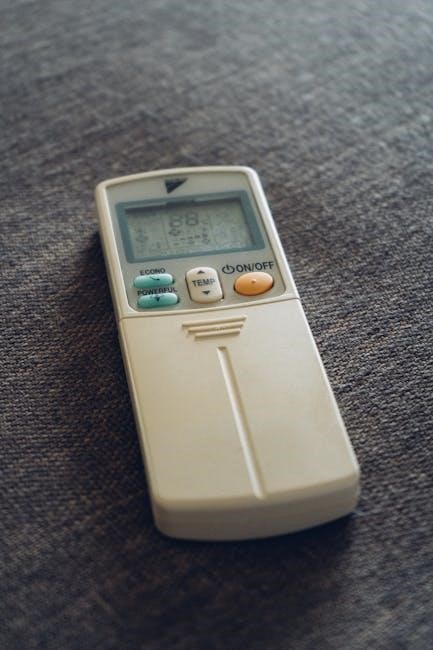
Locating the correct code is crucial when programming a universal remote for your air conditioner. Begin by checking the universal remote’s manual; it typically includes a comprehensive list of codes organized by brand. Consult the manual to verify if your specific AC brand is listed. If found, note the corresponding code(s) provided.
If your brand isn’t directly listed, the manual will likely offer a method for searching through codes. Many remotes categorize codes by manufacturer, so explore similar brands. Online resources and manufacturer websites can also provide code lists. Remember to test each code after entry to confirm functionality, pressing the power button to see if the AC responds. Accurate code entry ensures reliable control.
Automatic Code Search Method
The automatic code search is a convenient feature on many universal remotes. To initiate, typically you’ll press and hold the “Setup” or “Magic” button on the remote until the indicator light activates. Then, point the remote at your air conditioner and press the “Power” button repeatedly.
The remote will systematically send different codes to the AC, attempting to find a match. Observe your air conditioner closely; when it responds by turning on or off, immediately press the “Stop” or “Enter” button to lock in that code. This method eliminates the need to manually input codes, streamlining the setup process. Ensure a stable power supply to the AC during the search.
Manual Code Entry Method
Manual code entry requires referencing your universal remote’s code list, which is usually included in the manual. Locate your air conditioner’s brand within the list and note the corresponding four-digit code. With the remote powered on, press and hold the “Setup” or “Mode” button until the indicator light turns on.
Then, using the number buttons, carefully enter the four-digit code. After entering the code, press the “Power” button to test if the remote controls your AC. If it doesn’t work, repeat the process with another code listed for your brand. Patience is key, as multiple codes may be available.
Troubleshooting Common Remote Issues
Troubleshooting involves checking batteries, ensuring a clear line of sight, and verifying the correct code is programmed for your air conditioner.
Remote Not Responding
If your air conditioner remote isn’t responding, begin with the simplest checks. First, confirm that the batteries are fresh and correctly installed, paying attention to polarity. A weak signal is a common culprit. Next, ensure there’s a clear line of sight between the remote and the air conditioner’s sensor – obstructions can interfere with the signal.
Try pointing the remote directly at the unit and pressing the power button. If it still fails, double-check that the correct code has been programmed for your specific air conditioner brand. Sometimes, accidental button presses can alter the settings. Finally, a dirty infrared emitter on the remote can also cause issues; gently clean it with a soft cloth.
Incorrect Code Entered
Experiencing issues after programming your universal remote? An incorrect code is a frequent cause. If the remote operates other devices but not your air conditioner, revisit the code search process. Consult your remote’s manual for the code list specific to your AC brand. Remember, multiple codes might exist for the same brand – try them all sequentially.
If using the automatic code search, allow the remote to cycle through all possibilities. For manual entry, double-check each digit against the manual’s list. A single incorrect number can prevent proper operation. If problems persist, explore online resources or the manufacturer’s website for updated code lists or troubleshooting guidance.
Battery Problems
A seemingly unresponsive remote control often points to simple battery issues. Begin by verifying the batteries are correctly installed, observing proper polarity (+ and -). Even new batteries can be faulty, so testing with a known working set is advisable. Weak batteries may not provide sufficient power to transmit a signal to your air conditioner, resulting in intermittent or no response.
Consider the battery type required by your remote – typically AAA or AA. Avoid mixing old and new batteries, as this can reduce overall performance. If the remote has been unused for an extended period, battery leakage could occur, damaging the contacts; inspect and clean them carefully if necessary.

Smart Features & Wi-Fi Control
Modern air conditioners offer Wi-Fi connectivity, enabling remote control via smartphone apps and voice assistants for enhanced convenience and energy efficiency.
Remote Control via Smartphone Apps
Smartphone apps are revolutionizing how we interact with our air conditioning systems. These applications, often provided by the AC manufacturer or a universal remote brand, transform your mobile device into a powerful remote control. Users can adjust temperature settings, switch between cooling modes (auto, cool, dry, fan), and control fan speeds—all from anywhere with an internet connection.
Beyond basic controls, many apps offer advanced features like scheduling, allowing you to pre-set temperature changes throughout the day to optimize comfort and energy savings. Some apps even provide energy usage monitoring, helping you identify ways to reduce your electricity bill. The convenience of controlling your AC remotely, whether you’re at work or on vacation, is a significant benefit of these smartphone integrations.
Voice Control Integration
The integration of voice control with air conditioning systems represents a leap forward in home automation. Through compatibility with popular voice assistants like Amazon Alexa and Google Assistant, users can now manage their AC units using simple voice commands. Imagine saying, “Alexa, set the AC to 72 degrees,” or “Hey Google, turn off the air conditioner” – offering hands-free convenience.
This feature is particularly useful when your hands are full or when you’re across the room. Setting up voice control typically involves linking your AC’s smartphone app or a compatible smart remote to your voice assistant platform. Beyond basic on/off and temperature adjustments, voice commands can often control modes and fan speeds, enhancing the overall user experience and accessibility.
Scheduling and Automation
Modern air conditioner remotes, especially those with Wi-Fi capabilities, offer robust scheduling and automation features. Users can create customized schedules to automatically adjust the temperature based on the time of day or day of the week, optimizing energy consumption and comfort. For example, you can program the AC to lower the temperature before you arrive home from work.
Automation extends beyond simple scheduling. Geofencing allows the AC to respond to your location, automatically turning on or off as you enter or leave a defined area. These features, controlled through smartphone apps, provide significant convenience and potential cost savings by preventing unnecessary energy usage when the space is unoccupied, enhancing overall efficiency.

Maintaining Your Remote Control
Regular maintenance, including battery replacement and cleaning, extends the life of your air conditioner remote, ensuring reliable operation and preventing issues.
Battery Replacement Best Practices
Consistent performance of your air conditioner remote hinges on proper battery care. Always use the correct battery type, typically AAA or AA, as specified in the remote’s manual. When replacing, ensure correct polarity – matching the positive (+) and negative (-) terminals. Avoid mixing old and new batteries, as this can reduce overall performance and potentially damage the remote.
If the remote isn’t used frequently, remove the batteries to prevent corrosion from leakage. Store batteries in a cool, dry place. Consider using rechargeable batteries for an eco-friendly and cost-effective solution, but ensure they are fully charged before use. Regularly check for any signs of corrosion within the battery compartment and clean if necessary, using a soft, dry cloth.
Cleaning the Remote
Regular cleaning extends the life of your air conditioner remote and maintains optimal hygiene. Before cleaning, remove the batteries to prevent any accidental activation. Use a soft, slightly damp (not wet!) cloth to wipe down the remote’s surface. Avoid harsh chemicals, abrasive cleaners, or solvents, as these can damage the plastic and markings.
For stubborn dirt or grime, a cotton swab lightly dampened with isopropyl alcohol can be used to clean around buttons and crevices. Ensure the remote is completely dry before reinserting the batteries. Pay attention to cleaning the infrared emitter window, as dust accumulation can hinder signal transmission. A gentle brushing with a soft brush can help remove debris from this area.
Protecting the Remote from Damage
Protecting your air conditioner remote from physical damage is crucial for its longevity. Avoid dropping the remote, as internal components are sensitive to impact. Store the remote in a safe, dry place when not in use, away from direct sunlight and extreme temperatures. Consider using a protective case or cover to shield it from scratches and dust.
Keep the remote away from liquids; spills can cause corrosion and malfunction. If the remote does get wet, immediately remove the batteries and allow it to dry completely before attempting to use it again. Be mindful of pets and children who might chew or play with the remote, potentially causing damage. Gentle handling ensures continued functionality.